Trending...
- Grab-Tab Technology™ Introduces a Smarter Way to Use Tape
- Naperville: Municipal Election Petitions for Candidacy Available Tuesday, July 28
- Cover Story about Matthew Cossolotto – Author of Harness Your PromisePower -- Published in July 2026 Enterprise World Magazine
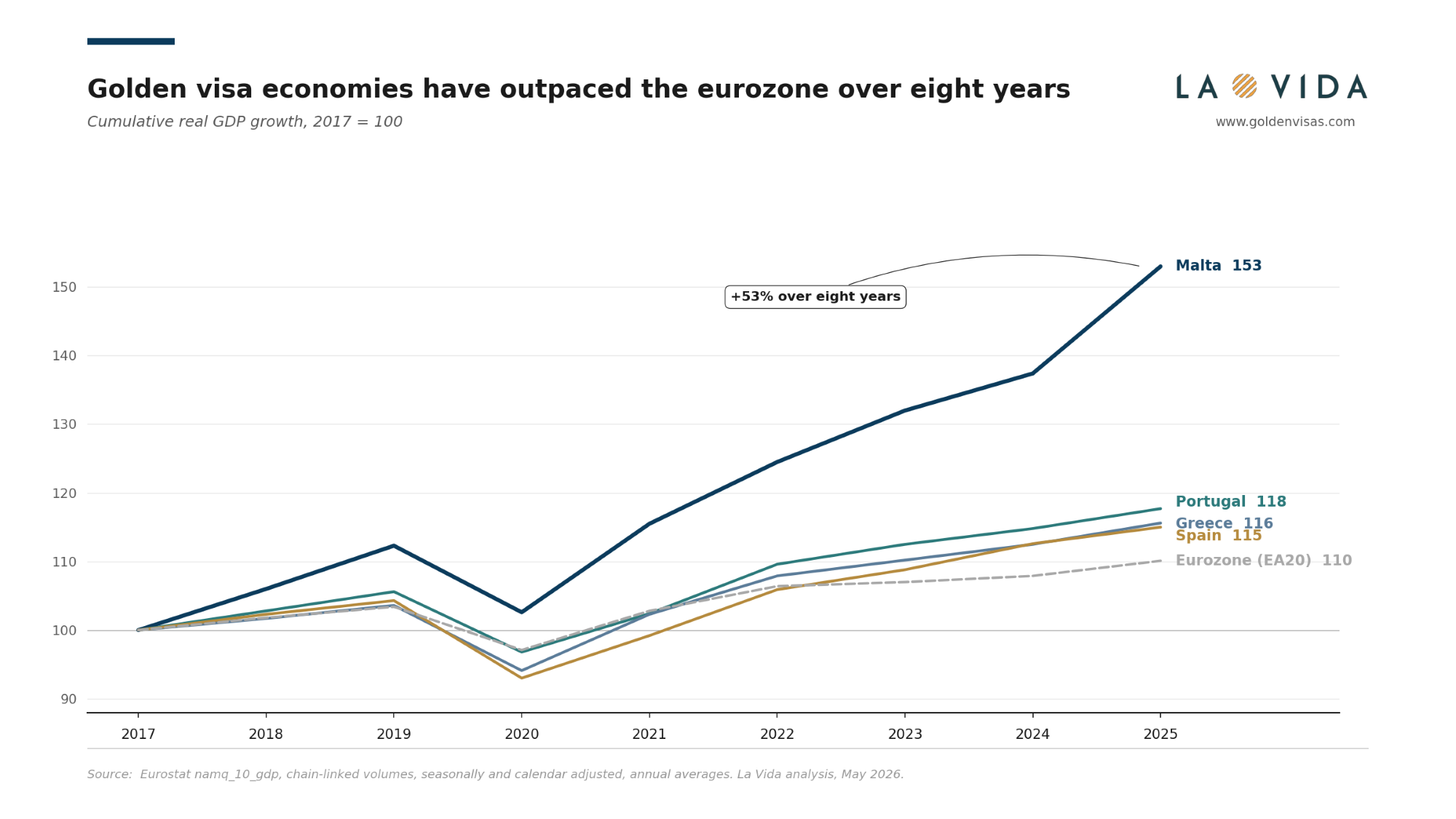

Real GDP in Malta, Portugal, Greece and Spain grew faster than the eurozone average from 2017 to 2025, according to research published today by investment migration firm La Vida. The four economies — all of which operated investment migration programmes throughout the period — outperformed the bloc on both aggregate and per-capita measures.
UXBRIDGE, U.K. - illiNews -- LONDON — The four European countries that ran continuous investment migration programmes from 2017 to 2025 each grew faster in real GDP terms than the eurozone average, new analysis from UK-based investment migration advisory firm La Vida has found.
Drawing on official Eurostat national accounts data, the research shows Malta's economy grew 53% in real terms over the eight years, Portugal by 17.7%, Greece by 15.6% and Spain by 15.0%. The eurozone aggregate over the same period grew 10.1%.
The pattern holds when adjusted for population. On a real GDP-per-capita basis, Malta grew by 22.4%, Greece by 19.3%, Portugal by 12.9% and Spain by 8.8%, against a eurozone figure of 7.7%.
More on illi News
Direct investment associated with the programmes themselves is too small to account for the difference. La Vida estimates the qualifying investment generated by the four programmes sits in the range of 0.025% to 0.25% of national GDP per year — an order of magnitude or more below the size of the growth gaps observed.
Paul Williams, CEO and Founder of La Vida, said:
"European economies are struggling for growth while government debt continues to climb. Governments and the EU need to take a closer look at the role residency and citizenship by investment can play in attracting productive wealth into their economies. Our analysis doesn't prove the programmes drove the growth gap. But the direction of the data is hard to ignore, and the contribution of wealthy migrants extends well beyond their initial qualifying investment — through businesses they start, taxes they pay over time, and capital they go on to deploy."
La Vida research identifies three non-exclusive readings of the data. Direct investment under the programmes contributed to growth through real estate, construction, government revenue and associated multiplier effects, but at a modest scale. A second channel runs through the entrepreneurial behaviour of programme beneficiaries themselves — investment beyond the qualifying minimum, business formation, employment creation and tax contributions over time. A third reflects shared characteristics across the four economies that drove growth independently of investment migration policy, including post-pandemic tourism recoveries, EU recovery fund allocations, services exports and recovery from the post-2012 sovereign debt crisis.
More on illi News
The European investment migration landscape has shifted markedly since the period analysed. Spain closed its programme in April 2025. Portugal removed real estate as a qualifying route in October 2023 shifting to Private Equity investment. Malta's citizenship-by-investment route was struck down by the European Court of Justice in April 2025, though its residence programme continues. Greece's programme remains open.
"The next eight years will not look like the last," Williams added. "Several of these programmes have been reformed or closed. But the debate about whether the underlying policy works — attracting wealth in exchange for residency or citizenship — is more relevant than ever. The UK has signalled interest in reintroducing an investor route. The US has its Trump Card proposal. Argentina has tendered for a new programme. Governments are looking at this again because debt levels and demographic pressures demand it."
The full analysis of GDP growth in golden visa countries, including methodology and source data, is available at www.goldenvisas.com/gdp-growth-in-eu-and-golden-visa-economies.
Drawing on official Eurostat national accounts data, the research shows Malta's economy grew 53% in real terms over the eight years, Portugal by 17.7%, Greece by 15.6% and Spain by 15.0%. The eurozone aggregate over the same period grew 10.1%.
The pattern holds when adjusted for population. On a real GDP-per-capita basis, Malta grew by 22.4%, Greece by 19.3%, Portugal by 12.9% and Spain by 8.8%, against a eurozone figure of 7.7%.
More on illi News
- What's New in Hokkaido, Autumn 2026
- CRG Awarded NASA SEWP VI Contracts in Categories B and C
- 100 Million Americans, One Overlooked Problem: Neurogut Wins a Seat in Gastro Incubator
- Heidi G. Villari of The Villari Firm, PLLC Named to Super Lawyers for the Tenth Consecutive Year
- Naperville to Celebrate National Night Out with Community Events on Aug. 3 and 4
Direct investment associated with the programmes themselves is too small to account for the difference. La Vida estimates the qualifying investment generated by the four programmes sits in the range of 0.025% to 0.25% of national GDP per year — an order of magnitude or more below the size of the growth gaps observed.
Paul Williams, CEO and Founder of La Vida, said:
"European economies are struggling for growth while government debt continues to climb. Governments and the EU need to take a closer look at the role residency and citizenship by investment can play in attracting productive wealth into their economies. Our analysis doesn't prove the programmes drove the growth gap. But the direction of the data is hard to ignore, and the contribution of wealthy migrants extends well beyond their initial qualifying investment — through businesses they start, taxes they pay over time, and capital they go on to deploy."
La Vida research identifies three non-exclusive readings of the data. Direct investment under the programmes contributed to growth through real estate, construction, government revenue and associated multiplier effects, but at a modest scale. A second channel runs through the entrepreneurial behaviour of programme beneficiaries themselves — investment beyond the qualifying minimum, business formation, employment creation and tax contributions over time. A third reflects shared characteristics across the four economies that drove growth independently of investment migration policy, including post-pandemic tourism recoveries, EU recovery fund allocations, services exports and recovery from the post-2012 sovereign debt crisis.
More on illi News
- Chris The Wiz Releases Can't Tell EP
- Elevate Your Sneakers With Crep Protect Trek Laces
- Meet Privateer: Tucson's High-Tech Security Force Built With Paramilitary Precision
- Axis International Presents Innovative Spoon Rest with Hinged Lid for Licensing Opportunities
- Dynamic Dachshund Dog Goes Global: Remember Point Launches a New Bilingual Children's Book
The European investment migration landscape has shifted markedly since the period analysed. Spain closed its programme in April 2025. Portugal removed real estate as a qualifying route in October 2023 shifting to Private Equity investment. Malta's citizenship-by-investment route was struck down by the European Court of Justice in April 2025, though its residence programme continues. Greece's programme remains open.
"The next eight years will not look like the last," Williams added. "Several of these programmes have been reformed or closed. But the debate about whether the underlying policy works — attracting wealth in exchange for residency or citizenship — is more relevant than ever. The UK has signalled interest in reintroducing an investor route. The US has its Trump Card proposal. Argentina has tendered for a new programme. Governments are looking at this again because debt levels and demographic pressures demand it."
The full analysis of GDP growth in golden visa countries, including methodology and source data, is available at www.goldenvisas.com/gdp-growth-in-eu-and-golden-visa-economies.
Source: La Vida Europe Ltd
Filed Under: Business, Government
0 Comments
Latest on illi News
- New Research: Deterministic Decompilation of Hermes Bytecode Back to Readable JavaScript
- Lionheart Holdings and KEO Energy Sign Letter of Intent for Proposed Business Combination
- Grab-Tab Technology™ Introduces a Smarter Way to Use Tape
- Marcus Christ Announces Singles: "The Hammer Goes Click" and "You Hate Me, I Hate You"
- Fatal FOMO May be Your Last Roll of the Dice
- Chicago is Invited to Get Your Kicks in Bronzeville™
- Book 'Elephants In The Room' Published by Speaking Volumes
- Martin A. Sumichrast Joins Hawkeye Systems, Inc. as Chairman of the Board
- Allstream Energy Partners Returns as a Media Partner for the 2026 API Inspection & Mechanical Integrity Summit in San Antonio
- Naperville: Downtown Parking Survey Open Until July 27
- Chicago: Mayor Brandon Johnson, Community Leaders Cut Ribbon on Grand Boulevard Office Project the Estate Escape
- City of Chicago Encourages Individuals Identified in the Illinois Accountability Commission Report to Come Forward as an Independent Review Moves Forward
- Chicago: Mayor Brandon Johnson Joins CREATE Program and Partners to Break Ground on Columbus Ave Rail Grade Separation Project (GS11)
- Chicago: Mayor Bradnon Johnson, Department of Business Affairs and Consumer Protection Honors Graduates of Business Education Program
- Mayor Brandon Johnson and DCASE Award More Than $1.3 Million to Chicago Artists Through 2026 Individual Artists Program Grants
- PokerStars & Ladbrokes veteran buys into Finnish news media Rahapelisanomat
- Former Judge Chris Oldner Honored as Best Lawyer by "D Magazine" for 6th Straight Year
- Missouri Hemp Businesses File Federal Lawsuit Challenging HB 2641
- Naperville Police Accepting Applications for Fall 2026 Citizen Police Academy
- Naperville's Retail, Financial Landscape Among the Best in the State